ChatGPT Course for Beginners: What Actually Works in 2026
August 15, 2026 · Updated September 30, 2026
Most beginner ChatGPT courses teach you prompts. The ones that work teach you workflows. Here's how to pick.
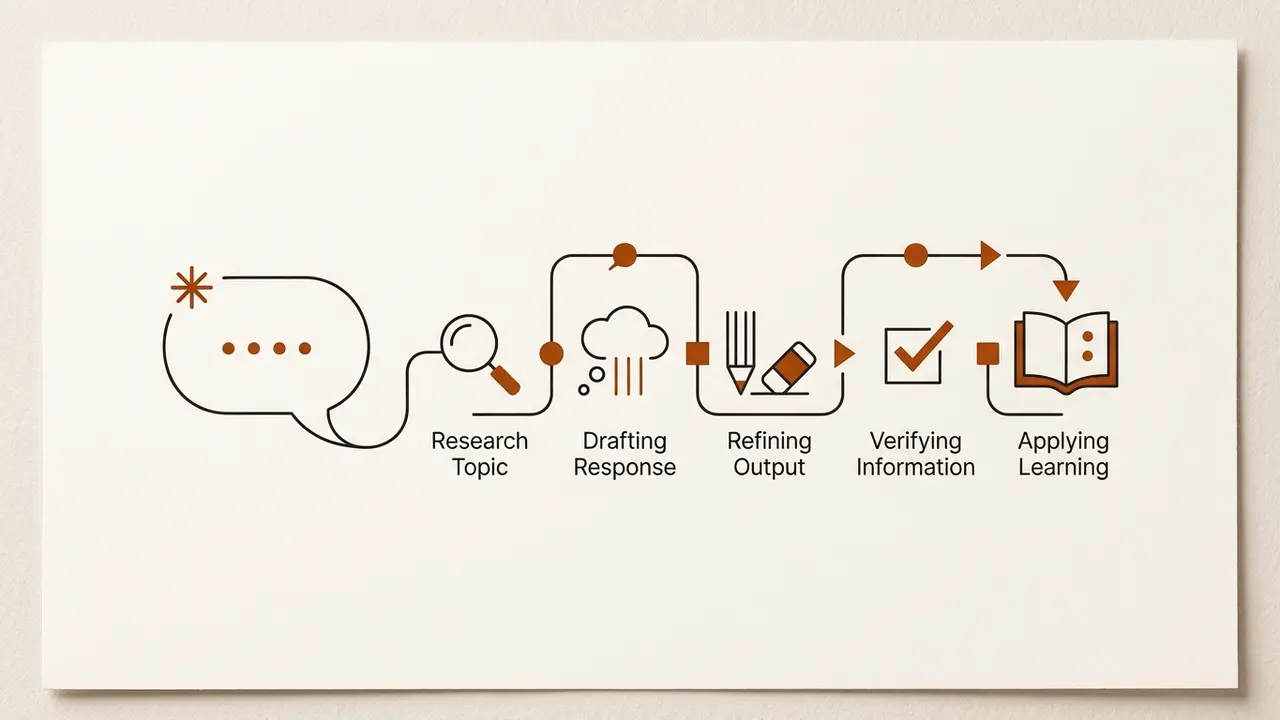
Most ChatGPT courses for beginners teach you how to write prompts. That is the wrong starting point. The people who get real value from ChatGPT at work are not running prompt frameworks. They are running workflows: a sequence of steps where ChatGPT handles one part and you handle the rest, and the output goes somewhere specific. A course that skips that distinction will leave you with a certificate and no change in how you work.
The honest answer to "what is the best ChatGPT course for beginners" is this: the best one is the one built around the tasks you already do, not the one with the longest syllabus. Everything below is how to figure out which course that is, and what to look for when you are comparing options.
What are you actually trying to get done?
Before you search for a ChatGPT course, name the task. Not "I want to learn AI." The task. The email you rewrite four times. The report you compile every Friday. The meeting notes nobody reads. The spreadsheet formulas you copy from Stack Overflow.
This matters because ChatGPT is not one tool. It behaves differently depending on what you ask it to do, and a course that treats it as a single skill is teaching you a single skill: typing into a box. The useful version of learning ChatGPT is learning where it fits into a process you already have.
Three questions that sharpen this:
- What output do you produce that takes too long or comes out mediocre?
- Where in that process is the bottleneck: gathering, drafting, structuring, or reviewing?
- Would you trust an AI draft of that output, or does it need to be perfect on the first pass?
If you cannot answer these, you are not ready for a course yet. You are ready to spend a week using ChatGPT on one real task and seeing where it helps and where it does not. That week will teach you more than any beginner module. If you want a structure for that week, our guide on how to learn ChatGPT for work lays out a four-week plan built around exactly this approach.
How do beginner ChatGPT courses actually differ?
The market splits into three rough categories, and they are not equal.
Free YouTube and blog tutorials. These are fine for orientation. They show you the interface, a few prompt tricks, and maybe a use case or two. They will not build a habit or a workflow. They are also the most likely to be outdated within months, because the product changes and nobody re-verifies.
Structured free courses (Great Learning, Coursera free tiers, etc.). These give you a syllabus and sometimes a certificate. The quality varies widely. Some are genuinely useful introductions. Others are padded with modules on transformer architecture that a working professional does not need. If you go this route, check whether the course was updated in the last few months and whether it shows real screenshots of the current interface.
Paid courses built for working professionals. This is where the format matters most. Our ChatGPT course is written against the live product, with dated verification sources, and anything older than about 90 days gets re-verified. Lessons are short, a few minutes each, readable or listenable. The point is not to give you a framework to memorize. It is to get you running a real workflow by the end of the session.
“The diagnostic question: does this course end with you doing something differently at work, or does it end with you knowing something?”
If the answer is "knowing something," it is a lecture, not training.
What should a good beginner course actually cover?
Based on what works in practice, here is the minimum a ChatGPT course for beginners should include:
- How the model actually behaves. Not the architecture. The behavior. What it is good at, what it confabulates, when it sounds confident and is wrong.
- Prompt structure for your task type. Not a universal framework. The specific structure that works for summarizing documents, drafting emails, generating code snippets, or analyzing data.
- Iteration and refinement. The first output is almost never the one you use. A good course teaches you how to steer the second and third pass.
- Where to plug it into an existing workflow. This is the part most courses skip entirely, and it is the part that determines whether you keep using the tool after week two.
- Limitations and failure modes. When not to use it. When to double-check. When the output looks right but is not.
If a course covers all five, it is doing its job. If it spends 40 percent of its time on the history of large language models, it is filling space.
How much should you expect to pay?
Free options exist and they are fine for a first look. But if you are a working professional trying to change how you do your job, free courses rarely have the structure or the currency to get you there.
Our subscription is $19/month or $149/year (about $12.42/month on annual). You can cancel anytime with one tap, and refunds are self-serve. The catalog currently has 19 courses live, covering tools like ChatGPT, Claude, Perplexity, and DeepSeek, plus role-based courses for accountants, project managers, and product teams. Every course includes a certificate with a public verification URL.
That pricing is on the page before your email. No gated demo, no "book a call." If the price is not visible, that is a signal about the business model, not the quality of the teaching.
Where this breaks down
A ChatGPT course for beginners cannot teach you judgment. It can show you how to get a draft, how to refine it, how to plug it into a process. It cannot tell you whether the output is good enough for your specific context, your specific audience, your specific stakes.
It also cannot keep up with the product indefinitely. ChatGPT changes. Features appear, interfaces shift, plan limits move. A course that was accurate in January may be misleading by August. This is why we re-verify against the live product on a roughly 90-day cycle, but even that is a lag. If you are learning from a course that was last updated more than six months ago, treat its screenshots and feature descriptions with suspicion.
Finally, no course can substitute for volume. The people who get good at using ChatGPT at work are the ones who use it daily, on real tasks, with real consequences. A course gets you started. Repetition gets you good.
How long does it take to learn ChatGPT?
Longer than a weekend, shorter than a semester, and the real variable is not the course. It is how often you use ChatGPT on work that matters to you. A beginner course compresses the awkward early stage. It cannot compress the practice part, because that part is you doing the work.
A realistic shape, assuming you are starting from zero:
- First session. Sign up, pick one real task from your week, and take it start to finish. ChatGPT has a free plan, so this costs nothing and teaches you more than an hour of tutorials.
- First week. One task per day, small and real. Rewrite one email, summarize one document, draft one status update. The goal is not mastery. It is learning what the tool does badly, because that is where judgment lives.
- Weeks two to four. Repeat the tasks that worked and build a structure around them: a saved prompt pattern, a review pass, a place for the output to land. This is the stage where a workflow starts to stick.
What stretches the timeline is not difficulty. It is practicing on fake tasks. People who start with invented exercises stay beginners longer than people who bring their own spreadsheet, their own inbox, their own report. The task supplies the feedback, and the feedback is what converts lessons into skill.
Most people who use ChatGPT daily on real tasks have something usable inside a month. Most people who only watch tutorials still cannot produce a decent draft after three months, because watching is not practice. If you want the structured version of that first month, the four-week plan in how to learn ChatGPT for work breaks it down task by task.
Beginner ChatGPT course questions
Is there a free ChatGPT course worth taking?
Yes, for orientation. The free tutorials and free course tiers compared above are a reasonable first look, and ChatGPT itself has a free plan, so you can practice on real tasks at zero cost. What free material rarely gives you is re-verified, current instructions and a structure that ends in a workflow. If you use a free course, check when it was last updated before trusting its screenshots.
Which AI course is best for beginners?
The one built around the tasks you already do. A course named after a tool you barely use will not beat a course aimed at your actual workload. If your work involves research, drafting, or analysis across several tools, our guide to the best agentic AI courses covers what separates the strong options from the padded ones.
How can I learn AI by myself?
You can, and most working professionals do. The pattern that works is task first, tool second: pick one output you produce every week, learn the AI features that touch it, and repeat until it is faster than doing it by hand. A course is a shortcut through that loop, not a requirement. Self-teaching fails for one predictable reason: no feedback. Either a course or a colleague who reviews your output fills that gap.
If you want a structured starting point, our ChatGPT course is built for exactly this: short lessons, real workflows, current interface. If you are comparing options across tools, this guide to online AI classes for professionals breaks down what to look for. And if you want to see the full catalog and pricing before deciding, start here. If you are choosing between ChatGPT and Claude as your starting tool, Claude vs ChatGPT for business maps where each one fits.